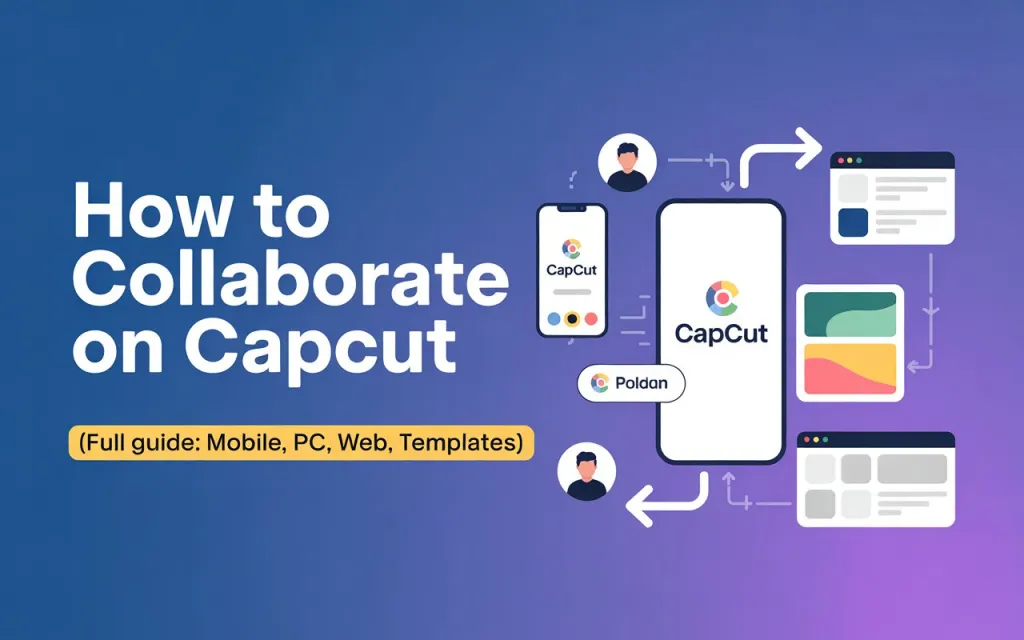
How to Collaborate on CapCut (Full Guide: Mobile, PC, Web, Templates)
CapCut has three genuinely different ways to work with other people, and picking the right one matters more than the mechanics of any single method — using the wrong one is the actual cause of most “collaborator can’t edit” problems.
Which Method to Use
Share Project Link — fastest, best for a single one-off collaborator. Sends a direct link that opens your actual project; whoever opens it can edit the timeline, layers, text, effects, and sounds directly. Good for a quick edit handoff to one other person.
Team Workspace — the right choice for ongoing team/agency work. Built for recurring collaboration: shared asset folders (video, music, logos, templates), member management via TikTok account/email/invite link, and version tracking so you can see who changed what. If you’re working with the same people repeatedly, this is worth the setup time; for a single one-time edit, it’s overkill.
Share as Template — the right choice when you want the format copied but not full editing access. A template link lets someone replace your clips while keeping your transitions, text, and color grading structure intact — but they can’t touch the underlying transitions/effects the way a full project share allows. This is the one most often mistaken for “sharing the project,” which is exactly why “collaborator can’t edit” is one of the most common issues (see below).
Sharing a Project (Mobile, PC, and Web)
The flow is nearly identical across platforms — open your project, tap/click Share, and choose “Share Project” (not “Share as Template,” unless that’s specifically what you want). You’ll typically see options for sharing via direct link, WhatsApp, email, or messaging apps.
- Mobile: Share icon (top-right on Android, bottom-right on iOS) → Share Project.
- PC: Share button, top right → Share Project Link.
- Web: Share (top-right corner) → Invite via link or email — and critically, the web version is the only one where you can set granular permissions (“Can edit” vs. “Can view only”) before sending, which makes it the best option if you want to control access precisely rather than an all-or-nothing link.
Whoever receives the link taps “Open in CapCut” or “Join Project” to start editing.
Setting Up Team Workspace
- Go to the Team tab → switch from Personal Workspace to Team Workspace.
- Create a team and add members by TikTok account, email, or invite link.
- Upload shared assets (footage, music, brand logos, templates) to the team folder — this is the main advantage over one-off project sharing, since assets don’t need to be re-sent for every new project.
- Changes sync in real time, with version history so you can track who edited what.
Common Problems, Ranked by How Often They’re Actually the Cause
1. You shared a template link when you meant to share the project (most common). If a collaborator says they “can’t edit” but can replace clips, this is almost always it — check whether you tapped “Share Project” or “Share as Template.”
2. Permissions set to view-only. Only relevant if you used CapCut Web’s permission controls — check the sharing settings before assuming it’s a bug.
3. Region-locked content. If the project uses region-restricted templates or sounds, a collaborator in a different region may hit access errors that look like a general “can’t open” problem but are actually regional restrictions on specific assets.
4. Sync issues. If changes aren’t appearing for collaborators: refresh the workspace, clear CapCut’s cache, and confirm assets have finished uploading to the cloud (large files can take longer than expected).
5. Team Workspace not visible. Usually resolved by updating CapCut, logging out and back in, or switching from mobile data to Wi-Fi — cloud-dependent features can behave inconsistently on unstable connections.
Practical Tips for Team Editing
Use CapCut Web’s comment feature for feedback on specific timeline points rather than describing timestamps in a separate chat.
Name files clearly before sharing — “final_v3_ACTUALFINAL” across a team folder wastes more time than it saves.
Avoid device-specific effects (some AI/hardware-dependent effects behave differently across devices) if collaborators are on different phones or platforms.
Export watermarked drafts for review rounds rather than the final unwatermarked export, so revisions don’t require re-exporting a full-quality file each time.